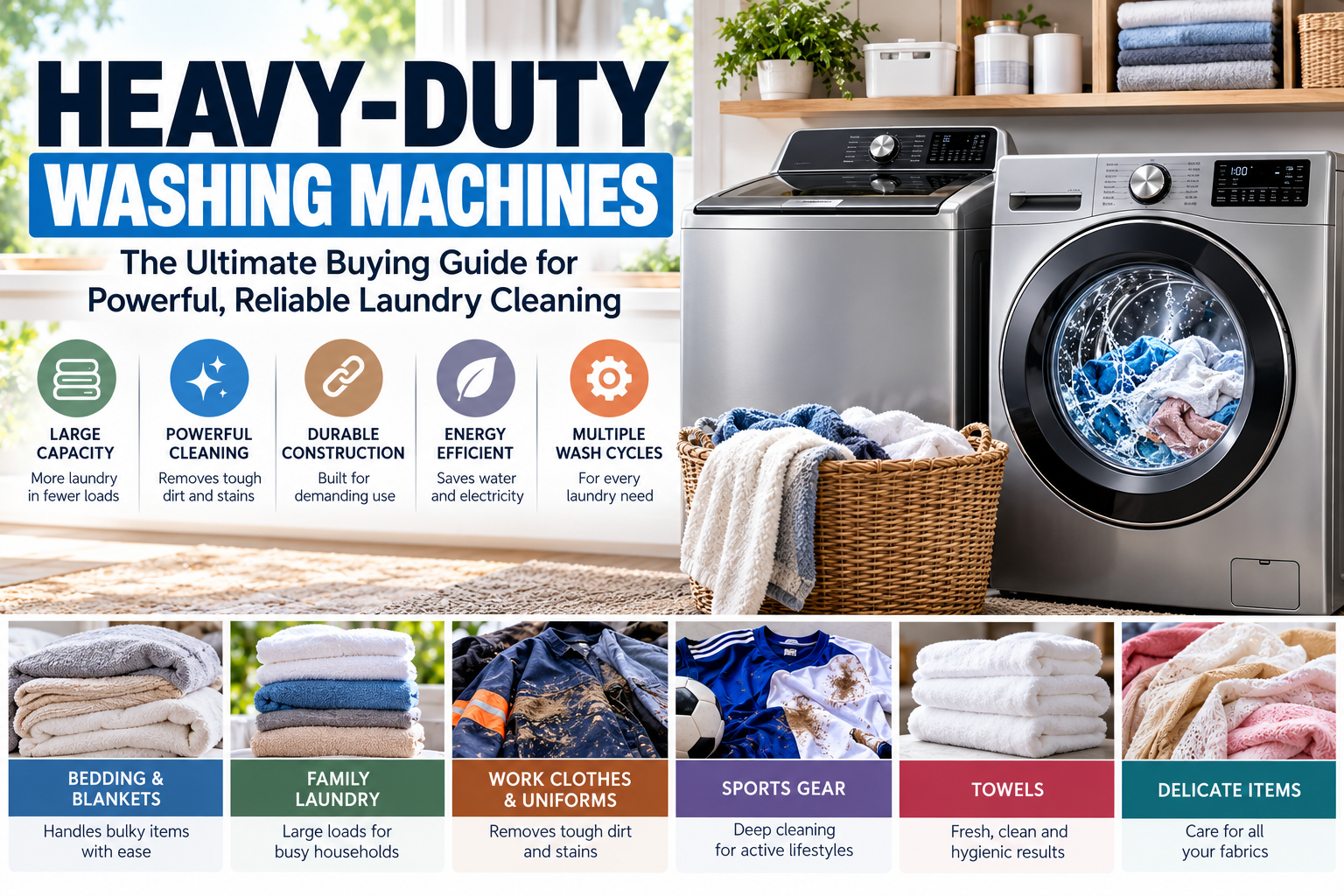
Laundry can quickly become overwhelming, especially for large families, busy households, and businesses that regularly wash bulky or heavily soiled items. A heavy-duty washing machine can make laundry day easier by providing greater capacity, durable construction, and cleaning cycles designed to handle demanding loads.
Whether you’re washing everyday clothing, thick blankets, work uniforms, or large bedding sets, choosing the right heavy-duty washer can save time and improve your laundry routine.
In this comprehensive guide, we’ll explore the different types of heavy-duty washing machines, their essential features, benefits, maintenance requirements, and what to consider before buying one.
What Is a Heavy-Duty Washing Machine?
A heavy-duty washing machine is designed to handle demanding laundry tasks, including large loads, bulky fabrics, and heavily soiled clothing.
Some heavy-duty washers are residential models featuring large-capacity drums and specialized wash cycles. Others are commercial-grade machines built for frequent use in laundromats, hotels, healthcare facilities, and other businesses.
It’s important to understand that a washer with a heavy-duty cycle is not necessarily a commercial-grade washing machine.
Commercial-grade models may offer more robust components, specialized warranties, and construction intended for frequent operation.
Benefits of Heavy-Duty Washing Machines
1. Greater Laundry Capacity
Many heavy-duty washing machines provide generous drum capacities, allowing you to wash more clothing or larger items in a single load.
This is particularly useful for families with children, households with frequent laundry needs, and people who regularly wash comforters and blankets.
2. Powerful Cleaning Performance
Heavy-duty wash cycles often use longer agitation or tumbling periods and specialized settings to remove stubborn dirt.
They can be particularly helpful for work clothes, sports uniforms, towels, and heavily soiled fabrics.
3. Durable Construction
Well-built heavy-duty machines may feature reinforced components, durable tubs, and motors designed for demanding washing conditions.
However, actual durability varies by manufacturer, model, and intended use.
4. Convenient Washing Programs
Modern washers often include cycles for bulky bedding, towels, delicate clothing, quick washes, and heavily soiled garments.
5. Potential Water and Energy Savings
High-efficiency washing machines can reduce water and electricity consumption compared with less efficient models.
Look for ENERGY STAR certification and compare the EnergyGuide labels of individual machines.
Types of Heavy-Duty Washing Machines
1. Heavy-Duty Top-Load Washers
Top-load washing machines are popular for their convenient loading design and familiar operation.
Some models use traditional agitators, while others feature impellers that create washing motion without a tall central agitator.
Best for: Households that prefer loading laundry from above and want a wide selection of capacities and washing mechanisms.
2. Heavy-Duty Front-Load Washers
Front-load washing machines clean clothes through a tumbling action and often use less water than conventional agitator-style top-load machines.
They can also provide strong cleaning performance and high-speed spin cycles that remove more moisture before drying.
Best for: Households seeking efficient operation, large capacities, and effective fabric care.
3. Commercial-Grade Washing Machines
Commercial-grade machines are designed for more demanding use, although their capabilities vary.
They may feature specialized components, simplified controls, and warranties that differ from standard residential models.
Best for: Businesses, rental properties, and buyers who need equipment specifically rated for their intended operating conditions.
4. Large-Capacity Residential Washers
Large-capacity washers are designed to handle substantial household loads, including towels, bedding, and family laundry.
Best for: Larger households and anyone who regularly washes bulky items.
Heavy-Duty Washing Machine Buyer’s Guide
Choosing the right washer involves more than simply purchasing the model with the largest drum.
Consider the following factors before making your decision.
1. Choose the Right Washing Machine Capacity
Washing machine capacity is typically measured in cubic feet in the United States.
| Capacity | Suitable use |
|---|---|
| 3.5–4.0 cu. ft. | Small to medium household loads |
| 4.1–4.5 cu. ft. | Everyday family laundry |
| 4.6–5.0 cu. ft. | Larger households and bulky loads |
| 5.1–5.5 cu. ft. | Large family loads and bedding |
| Above 5.5 cu. ft. | Extra-large loads where supported by the model |
These are general shopping guidelines. Actual load limits and bedding compatibility depend on the manufacturer’s specifications.
Buyer’s tip: A larger drum is useful, but overloading reduces cleaning effectiveness and may cause excessive vibration.
2. Compare Top-Load and Front-Load Models
| Feature | Top-load washer | Front-load washer |
|---|---|---|
| Loading | From above | From the front |
| Water efficiency | Varies by design | Often more efficient |
| Wash performance | Depends on model | Often excellent |
| Spin speed | Varies | Often higher |
| Maintenance | Usually easier door access | Requires gasket care |
| Installation | Cannot generally be stacked | Many models are stackable |
| Typical cycle time | Varies | Some cycles are longer |
Buyer’s tip: Choose based on verified model performance, available space, ease of use, and energy consumption rather than washer style alone.
3. Look for Essential Features
When comparing heavy-duty washers, prioritize practical features that match your laundry needs.
- Heavy-duty cycle: Designed for heavily soiled, durable fabrics.
- Bulky or bedding cycle: Helps accommodate comforters and other large items.
- High-efficiency operation: Can reduce water and energy consumption.
- Automatic load sensing: Adjusts water usage or cycle behavior based on the load.
- Steam settings: Available on selected models for specialized cleaning.
- High-speed spin: Removes more water before clothes enter the dryer.
- Vibration control: Helps reduce movement and noise.
- Smart connectivity: Offers compatible models remote notifications and cycle monitoring.
Remember that more features don’t automatically mean better reliability.
4. Understand the Price Ranges
Heavy-duty washing machines are available at different price points.
| Budget | Typical options |
|---|---|
| $500–$800 | Basic residential top-load and selected front-load washers |
| $800–$1,200 | Midrange washers with larger capacities and additional cycles |
| $1,200–$1,800 | Premium residential washers and selected commercial-style models |
| $1,800–$3,000 | Higher-end or specialized heavy-duty machines |
| $3,000+ | Selected commercial and professional laundry equipment |
These are approximate planning ranges, not current retailer quotations. Commercial equipment prices vary substantially by capacity and configuration.
Buyer’s tip: Include delivery, installation, required accessories, removal of your old machine, and potential repair costs when calculating the total purchase price.
5. Check Energy and Water Efficiency
An efficient washer can help reduce operating expenses over its lifetime.
Compare the following:
- ENERGY STAR certification
- EnergyGuide estimated annual electricity consumption
- Estimated annual operating cost
- Water consumption specifications
- Cycle efficiency and washing performance
The most efficient choice depends on your household’s laundry frequency, utility rates, and washing habits.
6. Evaluate Durability and Warranty
A reliable heavy-duty washing machine should offer sturdy construction and accessible maintenance support.
Before buying, investigate the motor warranty, parts coverage, labor coverage, availability of replacement parts, and local repair services.
A long motor warranty does not necessarily mean the entire washing machine is covered for the same period.
7. Measure Your Laundry Space
Before purchasing, measure the available installation area.
Consider the machine’s width, height, depth, door clearance, water connections, drain location, and electrical requirements.
Also check delivery pathways, including doorways, hallways, and staircases.
For front-load models, allow enough space to open the door fully.
Popular Heavy-Duty Washing Machine Brands
Several established appliance manufacturers offer large-capacity or heavy-duty washing machines.
Speed Queen
<Entity category=”brand” value=”Speed Queen” disambig=”Residential and commercial laundry equipment manufacturer”/> is known for residential and commercial laundry equipment, including models emphasizing durability and straightforward operation.
LG
<Entity category=”brand” value=”LG” disambig=”Consumer electronics and home appliance manufacturer”/> offers high-capacity front-load and top-load washers with features such as advanced wash cycles, smart connectivity, and energy-efficient designs.
Samsung
<Entity category=”brand” value=”Samsung” disambig=”Electronics and household appliance manufacturer”/> produces washers with large-capacity options, modern controls, and selected smart features.
Whirlpool
<Entity category=”brand” value=”Whirlpool” disambig=”American home appliance manufacturer”/> offers a broad selection of residential washers with practical cleaning cycles and various capacity options.
Maytag
<Entity category=”brand” value=”Maytag” disambig=”Home laundry and kitchen appliance brand”/> offers washers featuring heavy-duty cycles and designs marketed for demanding household laundry.
GE Appliances
<Entity category=”brand” value=”GE Appliances” disambig=”Household appliance manufacturer”/> provides front-load and top-load washers with a variety of capacity, cleaning, and convenience features.
Important: Brand reputation alone should not determine your purchase. Compare specific model specifications, independent reliability information, warranty terms, and service availability.
Best Heavy-Duty Washing Machines for Different Needs
| Your needs | Recommended washer type |
|---|---|
| Large family | 4.8–5.5 cu. ft. residential washer |
| Heavy work clothes | Washer with a dedicated heavy-duty cycle |
| Bulky bedding | Large-capacity washer with a bedding cycle |
| Limited laundry space | Stackable front-load washer |
| Lower utility consumption | ENERGY STAR-certified high-efficiency washer |
| Frequent business use | Properly rated commercial washer |
| Simple operation | Washer with straightforward controls and essential cycles |
Maintenance Tips for Heavy-Duty Washing Machines
Proper maintenance can improve performance and help prevent premature problems.
- Avoid overloading. Follow the manufacturer’s recommended load limits.
- Use the correct detergent. High-efficiency washers generally require HE detergent.
- Clean the washer regularly. Use the recommended tub-cleaning cycle.
- Inspect water hoses. Replace damaged or deteriorating hoses.
- Clean dispensers and filters. Follow the owner’s manual.
- Keep the machine level. An unbalanced washer can vibrate excessively.
- Maintain front-load door gaskets. Wipe away moisture and residue.
- Follow recommended service intervals. Address unusual noises, leaks, or error codes promptly.
Frequently Asked Questions
Are heavy-duty washing machines better than regular washers?
Heavy-duty washers can be better for larger loads, bulky fabrics, and heavily soiled laundry. However, a standard high-quality washer may be sufficient for everyday household use.
How long does a heavy-duty washing machine last?
Lifespan varies depending on construction, maintenance, usage frequency, and repair history. Commercial-grade construction does not guarantee a particular number of years.
Can a heavy-duty washer clean king-size comforters?
Some large-capacity washers can accommodate king-size comforters, but compatibility depends on the comforter’s size, thickness, and the washer manufacturer’s instructions.
Are front-load washers better for heavy-duty laundry?
Front-load washers can offer strong cleaning performance and efficient water use. However, individual models should be compared based on independent testing and specifications.
Is a commercial-grade washer worth buying for home use?
It may be worthwhile for households with unusually demanding laundry needs, but commercial-grade models can be more expensive and may have different installation or warranty requirements.
Heavy-Duty Washing Machine Buying Checklist
Before purchasing your next washer, make sure you have considered these important points.
-
Determine your household’s typical laundry volume.
-
Select an appropriate drum capacity.
-
Decide between front-load and top-load designs.
-
Check heavy-duty and bulky-load cycles.
-
Compare energy and water efficiency.
-
Measure your installation space.
-
Review noise and vibration specifications.
-
Compare warranties and repair support.
-
Calculate delivery and installation expenses.
-
Read independent reviews of the specific model.
Final Thoughts: Choosing the Best Heavy-Duty Washing Machine
A heavy-duty washing machine can be a valuable investment for households and businesses with demanding laundry needs.
The best washer isn’t necessarily the biggest or most expensive model. It’s the one that offers the right combination of capacity, cleaning performance, efficiency, reliability, and long-term value.
Before buying, compare models carefully, review manufacturer specifications, and choose a machine suited to your actual laundry habits.
Ready to upgrade your laundry room? Use this buyer’s guide to find a heavy-duty washing machine that delivers dependable cleaning, practical features, and lasting value.